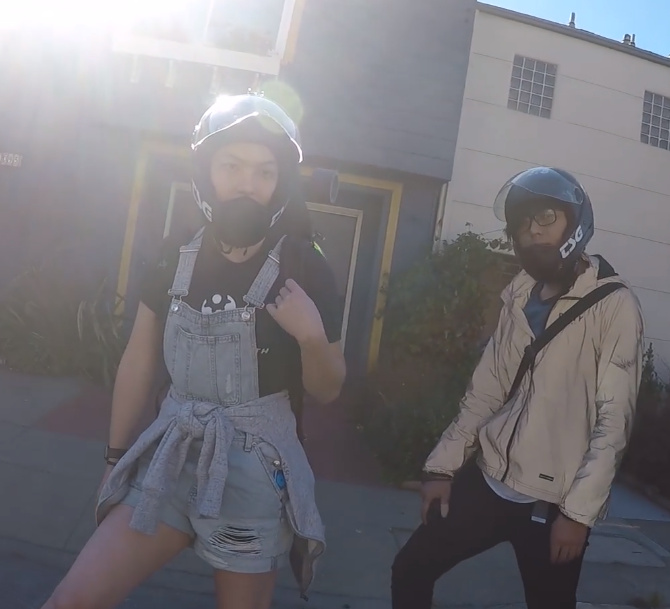
Promo video features two of our own 
6 Likes
They do not look that impressed
They are young and cool Brad 
1 Like
That’s a really good idea, and increasing the dead band would smoothly engage the third motor
If one day I manage to get my 4WD board there will be a lot of experimentation around this
Seeing what gets better consumption, all time 4WD vs using your solution, this would be awesome for off road, just accelerate a little more to engage 4WD
1 Like
It’s actually @Blasto’s solution, I’m just the messenger  . But I’m glad you found it useful. I’m gonna try it soon myself.
1 Like
Do some tests regarding what’s best, on all time vs increasing dead band vs if possible one way bearing on third motor
1 Like
I wore the same socks for all of the race days in Colorado. But I had like 10 pairs in the RV.
If the 3rd wheel brings your speed above ~32-33mph, the back emf voltage produced by your @hummieee hubs can easily exceed your pack voltage, potentially leading to an adverse riding condition…
2 Likes
@mmaner @Pedrodemio @deckoz …

- Voltage: 8V – 60V (Safe for 3S to 12S LiPo).
reference: VESC – Open Source ESC | Benjamin's robotics

2 Likes
It’s funny Bajaboard promised this on the first boards, a throttle for both front and rear… It never happened, I never pushed them of why it was missing but I guess this was the original idea - there for when you need it.
the special relativity experts on physics forums blink… 
@professor_shartsis "I’m confused by the image, because in a different thread it was stated:
[physics forums professor ]“the deceleration due to gravity is independent of the outward speed.”
[same physics forums professor ]" Actually, it isn’t; @kimbyd’s point is well taken, that “deceleration” actually affects γv, not v."
@metastable said:
Initial V=299792457.6086310810085m/s
A = cos(motion path angle relative to the vector from the observer to the source at the time when the light is emitted)
B = 299792457.6086310810085
C = C = 299792458m/s
D = cos(angle observed to source) = 0 = cos(90deg)A = -1 * ( ( ( -1 * B ) - ( D * C ) ) / ( C + ( D * B ) ) )
A = -1 * ((( -1 * 299792457.6086310810085 ) -( 0 * 299792458 ) )/ ( 299792458+( 0 * 299792457.6086310810085)))
A = 0.9999999986945338064792 = cos(0.00292766)
0 degrees + 0.00292766 degrees = 0.00292766 degrees blueshifted towards black hole
180 degrees - 0.00292766 degrees = 179.99707234 degrees redshifted away from black hole
0.00292766 / 180 = 0.00162647% of photons gravitationally blueshifted when initial V = 299792457.6086310810085m/s
100-0.00162647= 99.99837353% of photons gravitationally redshifted when initial V = 299792457.6086310810085m/s

^this has implications for cosmology since the main evidence for accelerating expansion comes from redshifts observed proportional with distance.
1 Like

3 Likes
Well, I am what I eat 
3 Likes
Changeable / swappable battery system, so you could use your own vesc’s and motors, something like a mellow drive, just without the drive and electronics. Batterys only up to 100 or 149wh, so you could have a few and fly with them. And afkorz easy 4 bolt mounting solution for the main case.
What I would like are some mechanical brakes, like the brakeboard but combind with a direct drive unit.
There are that already
Trampa sell them @Trampa
I would prefer something without a second hand controller and cable.
A couple of different topics which were too controversial for physics forums moderators:
I was out skateboarding the other day when I wondered if the efficiency of a vehicle attempting to cover the distance between point A and point B can be improved in the following manner. I put this thread in general relativity section since it involves gravity.
First I will share an example of the equations I would use to calculate the power consumption of a given standard land vehicle at a given speed in a given set of conditions.
peak mechanical power is 10746.218459832w
A = meters per second = XX.XXX
B = drag coefficient = 0.75
C = frontal area = 0.6m^2
D = fluid density of air = 1.225kg/m^3
E = wind drag force in watts
F = sine of 5% slope = sin(atan(5/100)) = 0.04993761694389223373491
G = acceleration of gravity = 9.80655m/s^2
H = vehicle mass in kg = 90.7184kg = 200lb / 2.20462lb/kg
I = mechanical watts required for constant speed up slope with no wind drag
J = mechanical watts required for constant speed up slope including wind drag
K = H * G * F
L = (1/2) * D * C * BE = ((1/2) * D * C * (A^2) * B) * A
I = H * G * A * F
J = E + I
J = (((1/2) * D * C * (A^2) * B) * A) + (H * G * A * F)
J = (1/2) * D * C * B * A^3 + H * G * F * A
J = (L * A^3) + (K * A)
^this can be rearranged to:
A=(sqrt(3) * sqrt(27 * J^2 * L^4 + 4 * K^3 * L^3) + 9 * J * L^2)^(1 / 3) / (2^(1 / 3) * 3^(2 / 3) * L) - ((2 / 3)^(1 / 3) * K) / (sqrt(3) * sqrt(27 * J^2 * L^4 + 4 * K^3 * L^3) + 9 * J * L^2)^(1 / 3)
we know:
J = 10746.218459832w peak mechanical
L = 0.275625 = (1/2) * D * C * B
K = 44.42622815547907982077 = H * G * Ftherefore:
A=(sqrt(3) * sqrt(27 * 10746.218459832^2 * 0.275625^4 + 4 * 44.42622815547907982077^3 * 0.275625^3) + 9 * 10746.218459832 * 0.275625^2)^(1 / 3) / (2^(1 / 3) * 3^(2 / 3) * 0.275625) - ((2 / 3)^(1 / 3) * 44.42622815547907982077) / (sqrt(3) * sqrt(27 * 10746.218459832^2 * 0.275625^4 + 4 * 44.42622815547907982077^3 * 0.275625^3) + 9 * 10746.218459832 * 0.275625^2)^(1 / 3)
A=32.32 meters per second
^therefore the peak velocity up slope is 32.32 meters per second
My question is would the following method potentially improve the energy efficiency of a given vehicle to cover the same distance between 2 points on land in the same time using less energy:
-First a track is constructed which consists of a series of parabolas (think of the trajectory of the “vomit comet” aircraft which is used for zero g astronaut training)
- The vehicle is modified so that, rather than its electric motor directly powering the wheels as in a standard automobile, its electric motor is used to force air into a high pressure tank
-The tank is connected to a compressed air thruster on the back of the vehicle, similarly to a reaction control system on a spacecraft
-The vehicle starts down the track, accelerating from gravity towards the bottom of the first parabola. Once it is almost at the bottom, it fires its compressed air thruster in a very short blast with just enough energy to surpass the next crest, and also in such a way that it eventually reaches point B in the same time as the standard vehicle.
For reference, unless mistaken I believe the parabola riding vehicle is taking advantage of an oberth manuever at the bottom of each parabola.
Will the compressed-air-powered parabola riding vehicle use less energy to reach the same distance in the same time as the standard electric vehicle?
I thought it might work because:
“The gain in efficiency is explained by the Oberth effect , wherein the use of an engine at higher speeds generates greater mechanical energy than use at lower speeds.”
I wasn’t sure if other factors might offset the potential efficiency benefits of this technique.
and:
I am looking at a class of problems in which there is a triple black hole system, all 3 have identical masses, equal initial separation distance, no orbital velocity, and are aligned such that the points which are their geometric centers are all along the same vector. A flashbulb which can fire a single flash uniformly in all directions of uniform photon frequency, is traveling at velocity V=299792457.6086310810085m/s (the same velocity at which an electron would have 10geV kinetic energy to a hovering observer) directly away from the central black hole, along a vector which is perpendicular to the vector which aligns the 3 black holes.
First to calculate the percentage of photons which will lose energy with each meter traveled from gravitational redshift (to a hovering observer) I use the relativistic aberration equation:
https://i.ibb.co/8XLW9pj/aberration.jpg
Relativistic aberration - Wikipedia
rearranged to:
D = (A-(B/C))/(1-((B/C) * A))
rearranged to:
A = cos(motion path angle relative to the vector from the observer to the source at the time when the light is emitted) = cos(E)
B = V = 299792457.6086310810085
C = C = 299792458
D = cos(angle observed to source) = 0 = cos(90deg) = cos(F)
E = motion path angle relative to the vector from the observer to the source at the time when the light is emitted in degrees = 0.00292766 degrees
F = angle observed to source = 90 degrees
G = degrees blueshifted towards black hole = 0.00292766 degrees
H = 179.99707234 = degrees redshifted away from black hole
I = 0.00162647% = % of photons gravitationally blueshifted
J = 99.99837353% = % of photons gravitationally redshiftedrearranged to:
A = -1 * (((-1 * B)-(D * C))/(C+(D * B)))
A = cos(E)
E = G
180 - G = H
G / 180 = I
100 - I = J
^If an electron at rest to the flashbulb has 10geV to a hovering observer, then no less than 99.99837353…% of photons from the flash will initially travel on a vector that is at least 90 degrees or greater from the vector which is directly towards the center of the central black hole.
Visualized it looks approximately like:
https://i.ibb.co/zQ7sTst/1-in-10000.jpg
My question is this:
On average, will the photons that lose a certain amount of energy per meter to a hovering observer in the scenario lose more energy per meter than would otherwise be the case if the 3 black holes had orbital momentum such that they did not infall to collision?
5 Likes
A while ago when I first got into boards I found this guy on facebook who had suggested adding a CVT transmission to his boards. He even bought a ton of custom boards but last I saw he was selling the decks on their own with enclosures on facebook, I think he gave up on the project. Here’s the video from “Voltige Board”
1 Like
The concept of CVT in esk8 has been thought of, but I don’t see an application, but i don’t see it applied : with electric motors, it will only cause a loss of efficiency and an up in you energy consumption, and with weak acceleration
3 Likes