At what moment in your life have you decided to study advanced physics ?!
Only starting a bachelor in Microtechnics and physic can already be a pain in the ass sometimes…
I don’t know
This one is still open:
Do black holes precess? I added some marks to a picture of quasar 3c175… can the highlighted distortion of the jet be interpreted as black hole precession?

[moderator] Precession will occur when an external force applies angular momentum to a spinning object that is not aligned with that objects spin axis. Accretion disks are, in general, not aligned exactly with the black holes spin axis - but the material becomes aligned before it nears the even horizon.
This process was modeled in a study just released this month:
Bardeen–Petterson alignment, jets, and magnetic truncation in GRMHD simulations of tilted thin accretion discs | Monthly Notices of the Royal Astronomical Society | Oxford Academic
(suggest you skip to “RESULTS”)According to the authors, the acretion disk does “torque” the black hole. So it would seem inevitable that the black holes spin axis would precess.
Very interesting. I was reading about axial precession on the Earth:
For precession, this tidal force can be grouped into two forces which only act on the equatorial bulgeoutside of a mean spherical radius . This couplecan be decomposed into two pairs of components, one pair parallel to Earth’s equatorial plane toward and away from the perturbing body which cancel each other out, and another pair parallel to Earth’s rotational axis, both toward the ecliptic plane.[20] The latter pair of forces creates the following torquevector on Earth’s equatorial bulge:[4]
If I understand correctly, the Earth requires non-spherical asymmetry for its precession to occur, is a black hole thought to be the same in this regard?

[moderator] A spinning black hole is not spherically symmetric, no. A non-rotating one is.
Don’t assume precession of a black hole has anything to do with forces, though. Gravity is not a force in general relativity.
2 Likes
I just had an idea for a future mountain board build
My plan is to use a custom direct drive for it, but if I go that route for 4WD it will be a lot heavier and expensive, so to solve that I would make it 4WD with 3 motors
On the front, a single 6355 or even 5055, just for the few moments you really need all for wheels providing traction, with a belt reduction, but inside each wheel pulley a one way bearing, so you avoid most of the belt drag and noise when just cruising with the two rear motors
I can even do a crazy reduction to give all the torque I need at low speed without worrying about frying a VESC in high speed since the motor will not spin at that time
2 Likes
(professor shartsis)
My question is would the following method potentially improve the energy efficiency of a given vehicle to cover the same distance between 2 points on land in the same time using less energy:
-First a track is constructed which consists of a series of parabolas (think of the trajectory of the “vomit comet” aircraft which is used for zero g astronaut training)
-The vehicle is modified so that, rather than its electric motor directly powering the wheels as in a standard automobile, its electric motor is used to force air into a high pressure tank
-The tank is connected to a compressed air thruster on the back of the vehicle, similarly to a reaction control system on a spacecraft
-The vehicle starts down the track, accelerating from gravity towards the bottom of the first parabola. Once it is almost at the bottom, it fires its compressed air thruster in a very short blast with just enough energy to surpass the next crest, and also in such a way that it eventually reaches point B in the same time as the standard vehicle.
For reference, unless mistaken I believe the parabola riding vehicle is taking advantage of an oberth manuever at the bottom of each parabola.
Will the compressed-air-powered parabola riding vehicle use less energy to reach the same distance in the same time as the standard electric vehicle?
(professor shartsis)
Perhaps some reasonable constraints (serving to limit the possible solutions) would be as follows:
-both vehicles cross the starting line with the same initial velocity, and it is the same velocity as the electric vehicle’s peak velocity
-the parabola riding vehicle only uses tunnels, and these can be as deep as the deepest point underground yet reached by man
-perhaps even easier to solve the problem if we do it backwards: figure out how fast the parabola riding vehicle can cover a ground distance under ideal circumstances with the constraint of the tunnel depth and initial velocity, and then determine how much power and efficiency the baseline vehicle gets covering the same distance in a straight line on land
(professor shartsis)
I want to know if there is a way to travel between 2 arbitrarily distant points on the surface in the same amount of time, that is more efficient than using an electric wheel-driven vehicle of the same mass, frontal area and drag coefficient traveling in a straight line along the surface.
(physics forum moderator)
You didn’t define all the necessary constraints, so for fun I’ll fill them in for you and say yes; the parabola accomplishes that. Now what?
(physics forum moderator)
This approach may have value, for example, when dealing with a mass transit system where you are entitled to fix the constraints (unlike for motor vehicles, where you can’t). A train could have curved tunnels to reduce travel time without increasing energy input, for example.
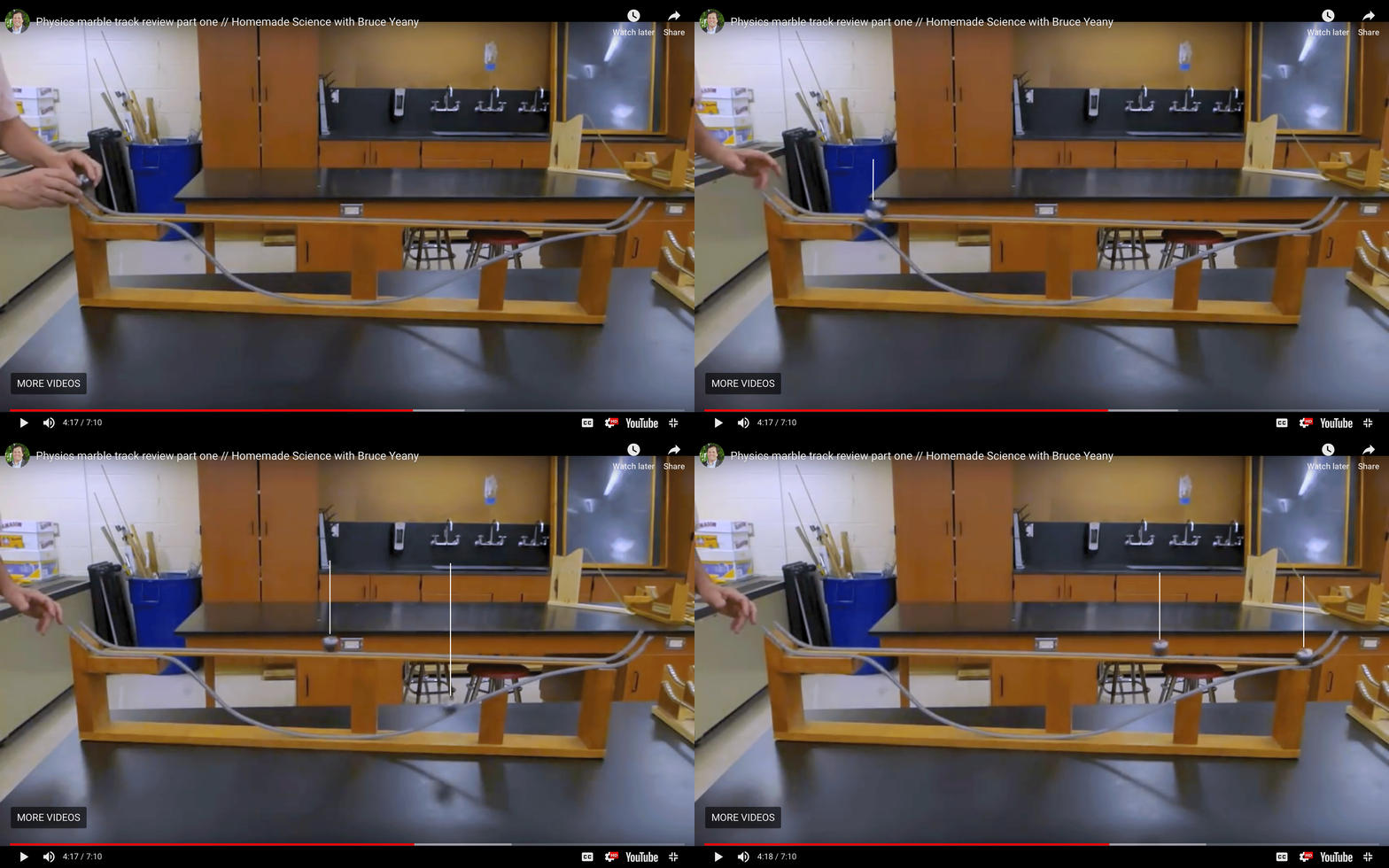
5min1sec:

2 Likes
Wow. Just wow.
2 Likes
(professor_shartsis)
Would the slope riding vehicle use less energy to cover the same ground distance in the same time in the following manner:
Both ground vehicle and slope vehicle initially have the same mass.
Suppose 1/2 of the mass of the slope vehicle is an apparatus consisting of a linear motor, push rod, and a light-weight tank filled with a heavy amount of water.
The slope riding vehicle and ground vehicle are both accelerated to 100mph with outside means. The ground vehicle covers 10 miles at constant 100mph. The slope vehicle, locked to rails, enters a 45 degree downward slope to a depth of 2.5 miles. At the bottom of the slope the linear motor launches the tank off the back of vehicle with enough force that the tank is at rest on the tracks. A valve opens on the tank dumping out the water on the tracks and the lightweight tank is later retrieved. The rest of the vehicle, now with 1/2 the original mass, continues down the flat track and then up another 45 degree ramp and then does a series of S turns before crossing the finish line at the same time and velocity as the ground vehicle. Did the slope riding vehicle use less energy?
(physics forums moderator)
No. It consumed potential energy in the form of the water in the tank.
(professor_shartsis)
Thank you. I meant can it potentially use less electrical energy to cover the same ground distance in the same time with the right parameters.
(physics forums moderator)
If your goal is to use less electrical energy, there are less Rube Goldberg ways of going about it. Use a gasoline engine, for instance.
(professor_shartsis)
I’m assuming the water will later evaporate so it won’t take any fossil fuels or electrical power to lift this water. If water can do the same thing as gasoline, well, I think it’s more renewable.

I think the ejecting of the weight on the vehicle so powerfully that it stays stationary on the track would be a lot of energy and no free lunch
@hummieee The ground vehicle is pushing off a reaction mass (the ground) which is moving away from the vehicle (in the rest frame of the vehicle) at 100mph.
The slope vehicle is pushing off a substantial reaction mass which is traveling at the same velocity as the vehicle, but which is also traveling at hundreds of mph relative to the ground with extremely high kinetic energy. The later case offers a tremendous mechanical advantage in terms of kinetic energy gained per final vehicle pound per kWh electrical energy expended. See the wiki on the Oberth effect.
(physics forum moderator)
Ok, you are really making this more complicated than needed. The Oberth effect says that if you burn a given amount of rocket fuel at a low speed then you gain less KE [kinetic energy] than if you burn that same amount of fuel at a high speed.
So have two “pinewood derby” vehicles both on a straight slope, both with identical rocket engines. One fires the engine at the top of the track and the other fires the engine in the middle. Determine the final KE [kinetic energy] of each at the end.
Ignore trying to match the starting and ending times, the Oberth effect says nothing about times. Don’t have different paths, the Oberth effect says nothing about paths.

one motor for lower speeds at a certain gear, with another motor with a higher “gear” on it that kicks in past a certain speed, allowing for high top speed along with low end torque… Thoughts?
the problem with doing that is the lower kv motor starts generating a higher voltage than the battery when you tow it past its no load speed. once the slower motor is towed fast enough it produces close to 60v and all the vescs on your board blink out… with hummie hubs this could happen when they are towed between about 40-45mph (their no load speed is 32mph or so at 12S). towing a slower motor above its no load speed is very dangerous and potentially costly in my opinion.
based on @hummieee hubs @ 12S
https://i.ibb.co/HGJgtLV/60v.jpg
1 Like
Anyone ever tried to build an electric long board to achieve the highest possible efficiency?
This weekend i found my old long board and decided to ride it around the block. After getting used to my electric board I was amazed at how little friction there is in a well setup longboard. If you spin the wheel by hand they will easily spin for more than 5 mins. I could coast around the whole block on only a few pushes.
It got me thinking that even single wheel belt drive has significantly more friction. I have never seen a drive system designed for low friction. Even a hub motor wont spin for more than a few seconds once you cut the power.
Is there is a method of drive that can give you almost zero friction freewheeling but still have the ability to have power and breaks?
I wonder what the lowest w/h per mile is you could get out of an electric board?
it would have to have no magnets to get a real coast like a wheel. I don’t know what Mellow boards are doing as I saw a video of their hub motor spinning really easily on a hand spin, but if you have magnets passing conductive material eddy currents are unavoidable and cogging.
I have to get a Bluetooth in my board and go for the most efficient mile possible and looking for a smooth track but I bet a street luge, with hub motors especially, would be super efficient with the lowest frontal drag. most efficient at higher speeds. anything above maybe even 15mph I bet the luge would beat everything.
2 Likes
Would just need a clutch.
However… why do you need free spin when you cut the power? Just because there’s drag w/o power doesn’t mean its being inefficient. There’s friction from belts and stuff, but the electrical drag in a hub motor isn’t there when its under power.
1 Like
how about a system like a hub motor but instead of coils inside you just have some crazy strong magnets to repel against the magnets mounted on the thane?
yeah this is what i was thinking. It would need to engage when applying power and disconnect when coasting. Maybe if you could pull the stator out of a hub motor whilst not being used you could remove the cogging force.
Also i was reading some data that suggests limiting motor amps doesn’t make much difference to range, limiting battery amps makes some difference but limiting Watts make a lot of difference.
I wonder if it would be possible to implement a mode similar to limiting Watts but with available watts varied based on speed effectively setting a Wh/Mile limit.
I know I’m late to the party here but that video his hilarious. It’s packed with “luxury features” - such as
Chrome Trim - Raised, right where your feet go
Aluminium wheels - Which are just thin covers over the core
Impeccable paint job - Paint
…and finally, Emblazoned with the exclusionary voltige emblem - Really? I’m not sure this chap knows what exclusionary means.
Is this what passes as luxury features in esk8? 95% marketing and 5% hopes and dreams.
2 Likes
full throttle is most efficient at higher speeds but lower speeds at partial throttle is even more efficient.
If you have a ironless motor you can achieve zero drag, look the JayKay e trucks, or something like that
Or you could do custom motors and have the laminations skewed, doing correctly would result is almost no drag
2 Likes