This is a question for @hummieee and @professor_shartsis and @MoeStooge but I think higher Kv is more efficient to some degree. I could be wrong. I know higher Kv / steeper gear ratio cogs less on unsensored startup.
@Halbj613 @b264 technically for the same size motor can and stator, winding the stator to be higher kv, and then using more gear reduction, will get more power out of the motor for the same heat generated. at a certain point the gear reduction ratio becomes absurd and also the iron losses will increase from additional eddy currents with the rotor turning faster, likely overtaking the copper losses at a certain rpm.
1 Like
@Halbj613 @b264 this is a crude representation I made a while back:

^It only applies when everything about the motor stays the same including the volume of copper in the motor, except for the geometry of the copper winding. when fewer turns of thicker wire is used (same copper volume) the kv increases, the resistance decreases, and the conductance, which is the inverse of resistance, increases. when the copper volume stays constant (!) it can be shown that changes in kv are proportional to the square root of changes in conductance. For example in the image above, if the area of the square which represents conductance doubles (which is the inverse of resistance), then the KV increases by a factor of the square root of 2.
1 Like
Small pole count Inrunners by design have a better copper to iron ratio. (more watts per square inch)
Direct Heat transfer to the can allows for stationary heat removal systems (water, Air)
I have ran as high as 8:1 ratio
On 4082 1450kv motors with great success.

Low pole count motors unsesored do cog. Even with low ratio gearing.
6 Likes
Wonder if you can elaborate on the poor design part, what in particular do you think is poorly designed about it or rather what can be drastically improved or is standing out like a sore thumb to you now? Personally only have self-taught understanding of how to design a PCB but no formal knowledge/training so I’m curious what kinds of mistakes were made to avoid in my own hobby work.
Also separately wondering how many of the things you stated about the poor motor design could be resolved without jacking the cost way up any insight into that would be nice as well.
Yes, this video was posted a while back and people got inspired, I wonder if any development was done since then, a forum for this must be created
I think you might be thinking of @pkasanda tbh but I could be wrong
1 Like
wuz up. in sf anytime soon?
remember reading this and thinking
3 Likes
As i blankly read your posts, i like to try and pretend like I understand so that i can almost feel what it is like to be that smart. Tell me, what is your recommended way into getting an elevated understanding with such complexities?
@hummieee you too you smart boi
1 Like
Humberg. Show us the light. You got a link?
No sorry can’t remember who is doing it. Maybe that fancy wood remote company. And there was another too I though The old skf or whatever that brand is off hobby king. They do with some long 63. It was the origin of the direct drive to many done w lathed hanger and slid on. if still made. Not sealed but skirt bearing. Not that it was extra ideal for skate being special other then being cheap powerful n the supportive skirt bearing.
@Zach u should read threads on endless-sphere and easy to get info on this stuff.
1 Like
The Maytech MTO6880 formerly sold through HyperIon Systems (@hyperion1)
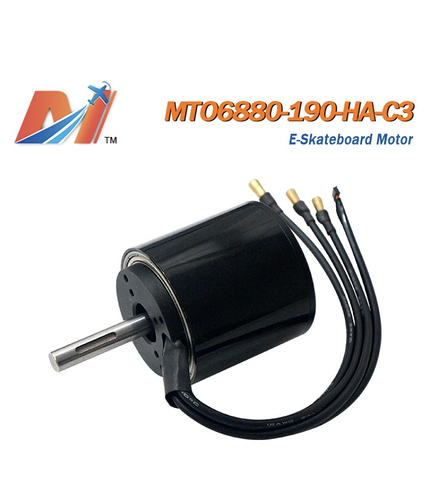
2 Likes


Weird idea that turned out to be a huge success.
Double wide dualies for extra torque transfer, longer wheelies, and better burnouts. They are extremely solid and should seriously help with my upcoming dual 80100 motors.
5 Likes
Wow those are ThICC motors
1 Like
@hummieee and @wafflejock
A few things
Encoders are definitely able to fit into motors. You can place a very thin disk on the back end of the can, inside the motor. A digital encoder or a mag encoder can work with similar size formats, and wouldn’t be thicker than a hall sensor array.
Spiral stators do a few things to benefit effeciency overall.
Flat bar magnets are pretty lame for such small motors, a 0.2mm air gap is small but that gap widens towards the edges of the magnets. Curved magnets are better and can even come with curved magnetic fields.
Halbach arrays are virtually impossible to find in our small motors, those would boost effeciency significantly.
As for the VESC, I’m pretty sure it doesn’t support field weakening. But good motor controllers will.
Field weakening basically uses the coils to nullify the field of the magnets, decreasing the field within the motor. This reduces back EMF and increases top speed.
I’d guess 15% higher top speed is achievable with no loss in low end torque. It’s inefficient though and will heat up your motors a bit. You can’t do it for a very long time or else you risk demagnetizing your magnets. It’s more of a “turbo” you use temporarily.
As for moving away from vesc, there’s a few reasons.
30,000 hz modulation on the mosfets is too low. There’s crazy effeciency losses at higher speeds because you simply can’t generate a proper sinusoidal wave at high E RPM’s. This is why they tend to blow up past 60,000 erpm. It’s not just the 2 vs 3 current shunt design.
Motors at our kinds of speeds should be running on 80 khz or higher frequencies. Otherwise they’re basically being driven by a square wave at higher rpm’s.
OH and also, electrolytic capacitors are bad. The giant ones on our vescs are not there because esc’s need them. They’re there to compensate for improper component selection. A well designed ESC will not need large ones like that, and certainly not electrolytic.
There’s a Korean vesc derivative thread on the old forum. He isn’t using large electrolytic caps, and everybody ripped him for it. Don’t think he’s made any sales of his design yet. But I can assure you that that’s the best designed vesc on the market right now, he knows what he’s doing and nobody sees that.
Oh, and I don’t like the unity’s design either. Same pitfalls as a vesc, at least design wise. I can’t speak for real world performance.
OH and one last thing about motors. We’re all being ripped off by China. You can buy significantly larger motors, like 120mm OD, 60mm L, for $50 bucks. These small 6380 motors are costing them MAYBE $10 to actually manufacture. Selling them for $100+ is INSANE when you could buy them in bulk for $25 each. We’re in a bubble.
14 Likes
Perhaps you ought to post some links to what you were specifically referring to? 
4 Likes
Until we see any of this on a rolling use case it means nothing.
I’d love to have it but wouldn’t dare buy it or try it until it’s been proven first. Anyone here even make mounts for such motors?
2 Likes
Skewered stators loose max torque and then end up inefficient w heavy loading. but have little cogging.
Hallbach array would be nice but huge work and with enough steel flux ring behind the magnets it’s pretty close performance
Higher Switching frequency gets more inefficient. 80k would be a lot of loss in esc
This idea started with the concept of a headphone splitter.
What if I added a charge port splitter to a higher amp charger?
Obviously this is a huge no-no because one pack would be full and the other would cut off or worse: one being charged over capacity while the other catches up. What if there was a smart “nozzle” between the boards’ charge heads and the parallel split? If it worked out correctly, say using a 6A charger for example:


You could rapidly charge one board, or slowly charge several. I just don’t know what magical black box needs to be implemented to make this happen. Chop chop you electronics wizards smarter than me!
1 Like
@Venom121212 Wouldnt you simply need that charger along with 3 DC regulators? I already do this on a DIY portable TV. I plug the cable, and one regulator charges the batteries while the second one regulates the current for the TV to be on at the same time without flickering